

Short answer: buying a home and sustaining the life you want here are related decisions, but they need two different budgets. After the purchase, plan for the costs that belong to the property (property tax, condominium fees, utilities, insurance, upkeep) and the costs that belong to your daily life (food, transport, health, leisure). Neither list is the same for every home, so the most reliable budget is the one you build from the actual figures of the property you are considering.
San Miguel de Allende is not universally cheap or expensive. Two homes with similar asking prices can cost very different amounts to keep: one may have low condominium fees and city water at the door, the other a large garden, a pool, a well and a longer drive to the supermarket. Your own choices matter just as much: how often you eat out, whether you hire help, and whether you live here all year or by season.
This guide explains what to include and how to check each figure before you make an offer. It does not repeat the purchase process or closing costs; for those, see buying property in Mexico as a foreigner and the costs of buying a home in San Miguel de Allende.
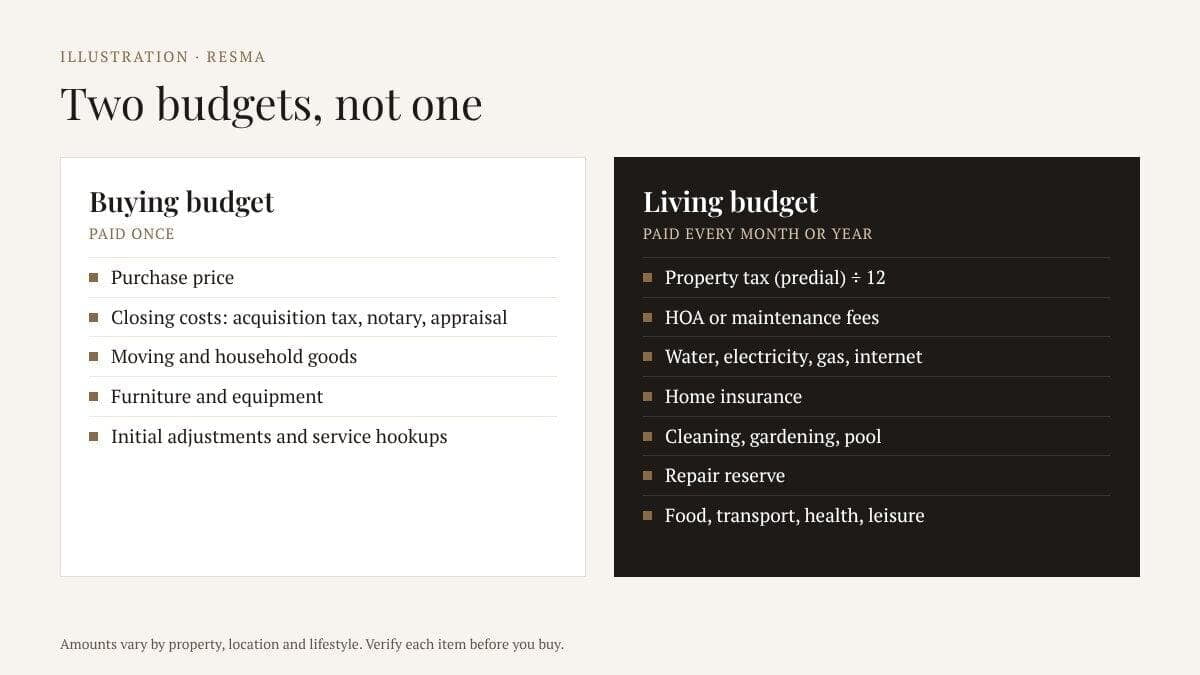
A. Costs that belong to the property
Property tax (predial): an annual bill you can spread over 12 months
Predial is paid to the municipality and is calculated on the property's fiscal value (valor fiscal) recorded by the cadastre, which is usually not the same as the market price. For 2026, San Miguel de Allende's revenue law sets marginal brackets for urban properties with buildings from 0.234% to 0.354%, a flat 0.207% for suburban properties with buildings, 0.18% for rustic properties, and separate rates for vacant land. The minimum annual tax is MXN 349.48, and paying the full year in advance earns a 15% discount in January or 10% in February (Ley de Ingresos 2026, arts. 4 and 49).
| Fiscal value (MXN) | Annual predial (MXN) | Monthly equivalent (MXN) | Paid in full in January (−15%) |
|---|---|---|---|
| 2,000,000 | ≈ 5,950 | ≈ 496 | ≈ 5,058 |
| 4,000,000 | ≈ 13,030 | ≈ 1,086 | ≈ 11,076 |
| 8,000,000 | ≈ 27,190 | ≈ 2,266 | ≈ 23,112 |
Calculation: (fiscal value − lower limit) × marginal rate + fixed amount, per art. 4, frac. I. Fiscal values are examples, not the value of any specific home. Rates apply to 2026 and are reviewed every year.
How to verify: ask the seller for the latest predial receipt. It shows the cadastral account, the fiscal value and what was paid, which is the best starting point for your own estimate.
Condominium or maintenance fees
In a condominium or gated community, the regular fee typically covers shared expenses such as security, common-area gardens, lighting and administration. What it includes, how it is updated and how special assessments are approved depend on that development's bylaws (reglamento) and its owners' assembly. Never assume that one development's fee applies to another, even next door.
Utilities: water, electricity, gas and internet
- Water. In homes served by SAPASMA, the 2026 domestic metered tariff starts with a base charge of MXN 117.60 per month plus a consumption charge. Drainage adds 20% and wastewater treatment 18.5% of the water amount for connected users (Ley de Ingresos 2026, art. 33). Using that table, 10 m³ a month comes to about MXN 266, 20 m³ to about MXN 538 and 30 m³ to about MXN 889 (our calculation). Some properties instead rely on wells, water trucks or cisterns, which follow a different logic.
- Electricity. CFE bills by household tariff. If a home's average consumption exceeds the high-consumption limit set for its tariff, it is moved to the DAC (high-consumption) tariff, which costs considerably more per kWh. Pools, electric heating and air conditioning can make the difference.
- Gas. Most homes use LP gas, from a stationary tank or cylinders; some areas have natural gas. Consumption depends on water heating, cooking and whether there is a heated pool.
- Internet. Speeds and providers vary by street, so confirm availability at the exact address, especially in rural areas.
Home insurance
Premiums depend on the value insured, construction type, coverage (fire, earthquake, theft, civil liability) and location. Ask an insurer for a quote using the property's real details before you close.
Cleaning, gardening and pool
Help at home is a personal choice, but some properties practically require it. A large garden needs regular care, and a pool needs cleaning, chemicals and electricity for the pump. If you hire staff directly, find out your obligations as an employer in Mexico before agreeing terms.
Repairs and preventive maintenance
Waterproofing roofs before the rainy season, servicing water heaters and pumps, and maintaining wood, ironwork and paint are regular tasks in this climate. A practical approach is to set aside a monthly reserve and adjust it to the age and condition of the house as described in an inspection.
Special assessments
Special assessments (cuotas extraordinarias) are approved by a condominium for specific works, such as repaving or a new security system. They are not monthly, but they can be significant. Ask whether any are approved, pending or under discussion.

B. Costs that belong to daily life
- Food and household shopping. Local markets, supermarkets and specialty stores coexist, and imported products usually cost more than local ones.
- Transport. In Centro and nearby neighborhoods many errands are on foot; in outlying areas a car becomes part of the budget (fuel, insurance, maintenance, parking).
- Restaurants, culture and activities. This line depends entirely on lifestyle and is often the one that varies the most from month to month.
- Personal services. Hairdresser, gym, classes, pet care, phone plans.
- Health care and insurance. Budget for insurance premiums, consultations, medication, check-ups and a reserve for deductibles and co-pays. Do not assume that a foreign policy or program covers you in Mexico: Medicare, for example, says it usually does not cover care outside the U.S. (Medicare.gov), and Canadian provincial plans set their own rules for care abroad. Mexico's IMSS offers a voluntary family health insurance with annual fees that vary by age, waiting periods and exclusions for pre-existing conditions; check eligibility and current terms directly with IMSS (IMSS-02-014) and compare private options with licensed providers.
C. How the budget changes with the type of home
These three situations are illustrations, not profiles of any neighborhood. Conditions vary from street to street and from one development to another.
| 1. Urban home near services | 2. Condominium with fees and amenities | 3. Country property with land | |
|---|---|---|---|
| Recurring property costs | Predial, utilities, upkeep of the house itself. | Predial and utilities plus a monthly fee that may cover security, gardens and amenities. | Predial (the classification may differ), utilities and the upkeep of land, fences, roads or wells. |
| Services | Usually municipal water and drainage. | Depends on the development: municipal network, own system or a mix. | Often well, cistern, septic system or water trucks; check internet coverage. |
| Transport | Many errands on foot. | Depends on location; a car is common. | A car is practically essential; more trips and longer distances. |
| Where surprises tend to come from | Older roofs and installations. | Special assessments and fee increases. | Garden, pool, pumps and road maintenance. |
No option is better for everyone. Some buyers value having maintenance largely organized by the condominium; others prefer space and privacy and accept a larger upkeep budget. To explore areas, see our neighborhood guides and prices in San Miguel de Allende.

D. Living here all year or by season
An empty house still has costs. Predial, condominium fees, insurance, minimum utility charges and basic upkeep continue whether or not you are here. What falls when the house is unoccupied are mostly consumption-based items: water and electricity use, gas, groceries, and transport.
Seasonal owners should also budget for someone to check the property, run water and pumps, ventilate, receive deliveries, deal with rainy-season leaks and pay bills on time. These services can be contracted with independent property managers or caretakers; agree the scope, frequency and cost in writing.
E. Income in dollars, expenses in pesos
Most local costs are paid in Mexican pesos, while many buyers receive income in US or Canadian dollars. Three habits help:
- Build the budget in pesos, because that is how predial, utilities and fees are charged.
- Convert with a dated reference rate and review it periodically. For example, at the FIX rate determined by Banco de México on 12 Nov 2026, 18.6188 pesos per US dollar, MXN 10,000 equals about USD 537 (Banxico). This is a snapshot, not a forecast or a fixed cost.
- Keep a margin for exchange-rate movements and for transfer and card fees, which you can confirm with your bank.
F. One-time costs that do not belong in the monthly budget
Keep these separate so they do not distort your monthly picture:
- Moving and, if applicable, importing household goods (check current customs rules with a customs broker).
- Furniture and household equipment.
- Equipment such as water heaters, filters, pumps or security systems.
- Initial adjustments, repairs or remodeling.
- Contracting or transferring services: water, electricity, gas, internet.
Closing costs (acquisition tax, notary, appraisal, registry) are covered in our closing-costs guide.
Checklist: what to include and how to verify it
| Item | Frequency | What it depends on | How to verify before you buy |
|---|---|---|---|
| Property tax (predial) | Annual (can be paid in advance) | Fiscal value and classification of the property | Latest predial receipt; cadastral account |
| Condominium / maintenance fee | Usually monthly | Bylaws, services and amenities of the development | Current fee in writing from the administration; bylaws; statement of no debt |
| Special assessments | Occasional | Assembly decisions and planned works | Recent assembly minutes; ask about approved or pending works |
| Water and drainage | Monthly | Consumption, supply source, garden and pool | Recent bills; type of supply (network, well, truck) |
| Electricity | Bimonthly or monthly | Consumption, tariff, pool, heating and cooling | Last 12 months of CFE bills; check for DAC tariff |
| Gas | When refilled | Water heating, cooking, pool heating | Tank capacity and recent refill receipts |
| Internet | Monthly | Provider coverage at the address | Confirm availability and speed for the exact address |
| Home insurance | Annual | Value, construction, coverage and location | Quote from an insurer with the property's details |
| Cleaning and gardening | Weekly or monthly | Size of house and garden; your preferences | Ask the seller how upkeep is currently organized |
| Pool | Weekly / monthly | Size, heating, equipment | Maintenance records and equipment age |
| Repair reserve | Monthly reserve | Age and condition of the house | Professional inspection; history of repairs |
| Supervision (seasonal use) | Monthly | Time away and level of service | Written quote from the provider you choose |
Build your own monthly budget
Enter your estimates in Mexican pesos. Divide annual items by 12. The exchange rate field is only a reference; update it with the rate on the day you calculate.
| Item | Monthly amount (MXN) |
|---|---|
| Total per month (MXN) | |
| Total per month in your currency |
Default reference: Banxico FIX of 18.6188 MXN per USD, determined 12 Nov 2026. For CAD, replace it with the current MXN/CAD rate. Your entries stay on your device.
What to ask before making an offer
When available, ask the seller or the administration for:
- Recent utility bills (water, electricity, gas, internet).
- The current condominium fee, in writing, and what it includes.
- Information on any special assessments approved, pending or under discussion.
- The history of maintenance and repairs: roof waterproofing, plumbing, electrical, water heater, pumps.
- Costs and conditions of services tied to amenities (pool, gym, clubhouse, security).
- Details an insurer will need for a quote: built area, construction type, year, existing coverage.
Knowing the real running costs lets you compare two homes with similar asking prices on equal terms. Over several years, the difference in monthly costs can matter as much as a difference in price. If you are also weighing a new development, see resale vs. pre-construction, and for context on the market, our 2026 market review.
Find a home that fits your life and your budget
Your next home should fit both your lifestyle and your budget. At RESMA, we can help you compare locations, property features, and the known ownership costs of the homes you are considering.
Explore PropertiesSpeak with RESMASearch the AMPI MLSSources
- Ley de Ingresos para el Municipio de San Miguel de Allende, Gto., ejercicio fiscal 2026 (P.O. 260, 30 Dec 2025): art. 4 (predial), art. 33 (water, drainage and treatment), art. 49 (minimum and discounts). Consulted 13 Nov 2026.
- Banco de México, daily exchange rates (CF102): FIX 18.6188 MXN/USD, determined 12 Nov 2026.
- Medicare.gov, Travel outside the U.S. Consulted 13 Nov 2026.
- IMSS, Incorporación al Seguro de Salud para la Familia (IMSS-02-014). Consulted 13 Nov 2026.
- Worked examples for predial and water: RESMA calculations based on the 2026 tables cited above.
Related reading: buying as a foreigner · closing costs · prices · neighborhoods · Director's notes